
Sabarna Roy Choudhury
The Sabarna Roy Choudhury Family and the History of Kolkata
The history of Kolkata, formerly known as Calcutta, is closely linked to the Sabarna Roy Choudhury family of Barisha. The family played an important role in several early developments of the city. Its legacy includes the first pucca road, an early pucca house, one of Kolkata’s oldest Durga Puja traditions, and the historic leasing of Kalikata, Sutanuti, and Gobindapur to the British East India Company.
The family traces its lineage to Maharshi Sabarno. According to family tradition, Sage Vedagarbha settled in Bengal during the 10th century under King Adishura. His descendants later adopted the title Gangopadhyay.
One notable descendant was Panchanan Gangopadhyay. He served as a distinguished Mughal general under Emperor Humayun. He received jagirdari rights over 85 villages in present-day North 24 Parganas. He later established Halisahar as an important centre of the region.
Lakshmikanta Gangopadhyay and Early Kolkata
Lakshmikanta Gangopadhyay, born in 1570 at Kalighat, became the most prominent figure in the family’s early history. His activities strengthened the family’s connection with the area that later became Kolkata.
Lakshmikanta developed Sutanuti into an important centre for cotton trading. He also built the first pucca road connecting Halisahar with Kalighat. In 1610, he began the family’s famous Durga Puja tradition at Barisha.
His administrative achievements earned him the titles Roy Choudhury and Majumdar. Before the British established their presence, the family maintained its kachhari and temple near the area now known as B.B.D. Bagh.
In 1698, the Sabarna Roy Choudhury family leased Kalikata, Sutanuti, and Gobindapur to the British East India Company under Mughal authority. The family then moved its principal residence to Barisha. It continued to receive annual rent from the British for several decades.
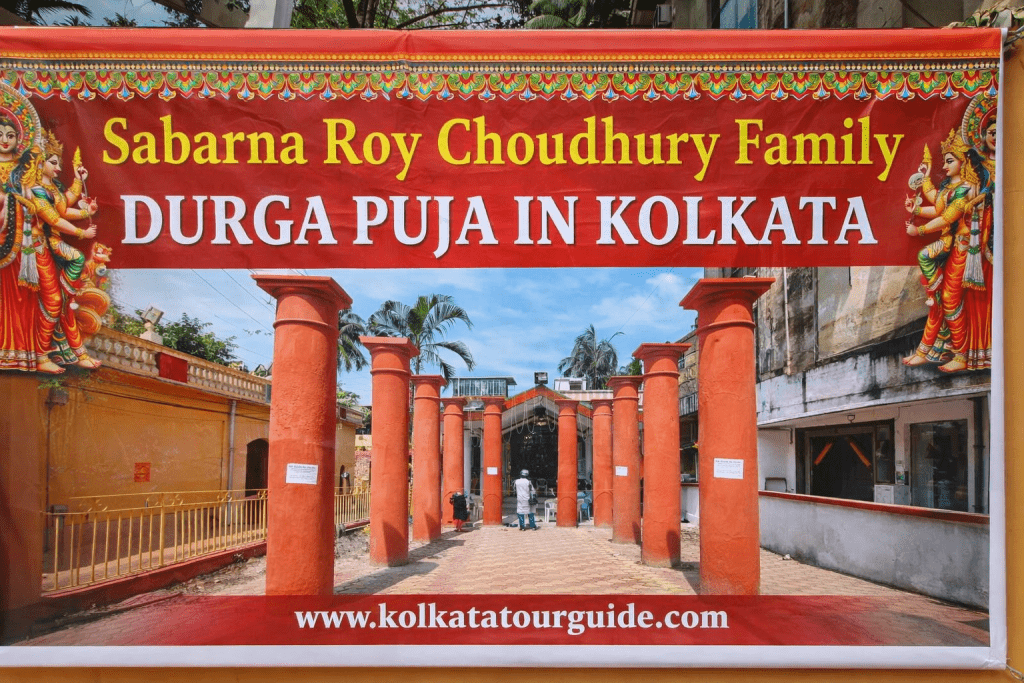
Sabarna Roy Choudhury Family Durga Puja In Kolkata
The Sabarna Ray Chaudhury family, founders and early zamindars of Calcutta, have been celebrating Durga Puja since 1610, making it one of the oldest surviving Durga Puja traditions in Kolkata. The puja was initiated by Laksmikanta Gangopadhyay at the ancestral Aatchala Bari in Barisha, which still stands today. This family puja is now over 400 years old.
Currently, eight Durga Pujas are conducted by different branches of the family—six in Barisha (Aatchala, Baro Bari, Mejo Bari, Benaki Bari, Kalikingkar Bhawan and Majher Bari), one in Birati, and one in Nimta—preserving age-old rituals of bonedi (aristocratic) household worship.
Historically, the Sabarna Ray Chaudhury family were the zamindars of Sutanuti, Kalikata and Gobindapur before the British arrived. In 1698, they were compelled to lease these villages to the British East India Company, an event that laid the foundation of colonial Calcutta. Despite this, the family remains deeply significant in Bengal’s cultural history, with their Durga Puja tradition symbolizing continuity, heritage, and Bengali identity across centuries.