
Shobhabazar Rajbari: A Historic Royal House of Kolkata
Shobhabazar Rajbari, one of Kolkata’s oldest aristocratic heritage houses, dates back to the mid-18th century. Raja Nabakrishna Deb established the Rajbari and became an influential figure in early colonial Kolkata. Located in Shobhabazar, near Shyambazar, the palace reflects the grandeur, culture, and social history of old Kolkata.
Raja Nabakrishna Deb built strong ties with Robert Clive and the British East India Company. These connections helped him gain prominence during the early British period in Bengal. At the same time, he played an important role in the cultural life of Kolkata.
In 1757, after the Battle of Plassey, Raja Nabakrishna Deb began the famous Durga Puja at Shobhabazar Rajbari. The celebration soon became an important social and cultural event in Kolkata. British officials, Indian aristocrats, artists, scholars, and other prominent guests attended the festivities.
Over the years, the Rajbari became closely associated with Kolkata’s evolving cultural identity. Its Durga Puja tradition also helped establish the city’s reputation for grand community celebrations.
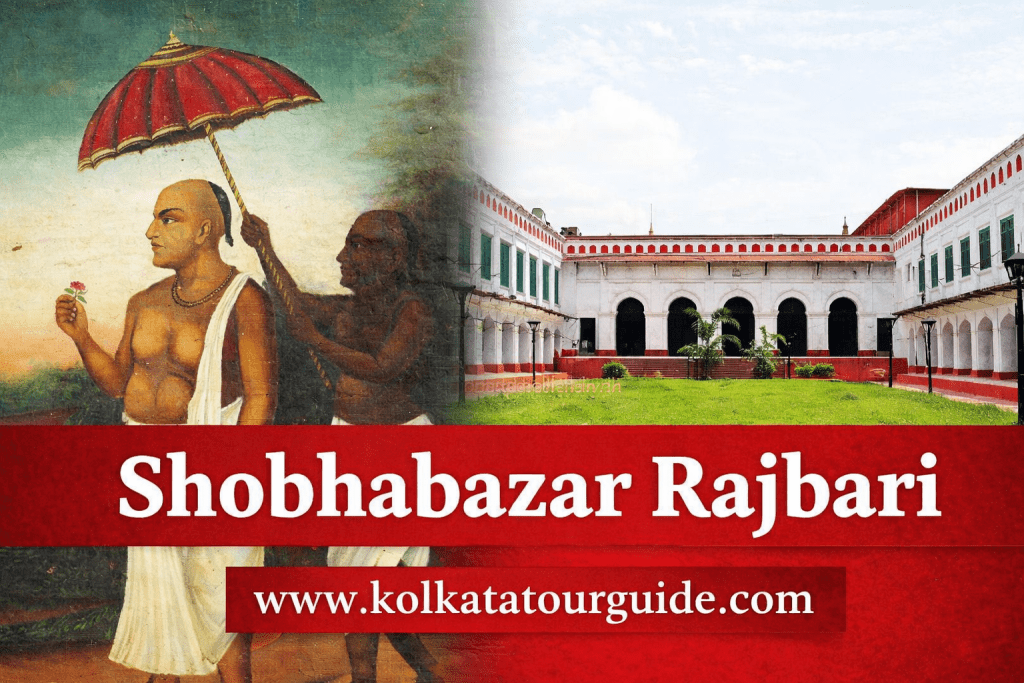
Architecture and Heritage of Shobhabazar Rajbari
One of the most striking features of Shobhabazar Rajbari is the Nat Mandap, also known as the Thakurdalan. The large open courtyard features imposing columns and traditional arches. The royal family once used this space for religious ceremonies, cultural performances, festivals, and social gatherings.
Although parts of the palace show signs of age, the Rajbari still retains its historic character. Its architecture offers visitors a glimpse into the lifestyle of Kolkata’s old aristocratic families.
Moreover, the annual Durga Puja at Shobhabazar Rajbari continues to attract visitors interested in Bengali culture and heritage. The celebration usually takes place during the autumn festival season in September or October, depending on the Bengali calendar.
Shobhabazar Rajbari and Raja Nabakrishna Deb
The legacy of Raja Nabakrishna Deb remains closely connected with Kolkata’s history. His association with Robert Clive and the British East India Company forms an important part of the Rajbari’s story.
The palace also connects with the wider cultural changes that shaped 18th- and 19th-century Bengal. Its festivals, architecture, and family traditions provide valuable insight into Kolkata’s aristocratic past.
Durga Puja at Shobhabazar Rajbari: History and Heritage
“Durga Puja at Shobhabazar Rajbari: A Tryst with History and Heritage,” an initiative organized with Rritobak, presented the Rajbari’s centuries-old Durga Puja tradition through the illustrations of Shri Prabir Krishna Deb, a descendant of Raja Nabakrishna Deb.
The project used an animated video to bring these illustrations and historical stories to life. It also explored the connection between Raja Nabakrishna Deb, Robert Clive, and the famous Durga Puja of 1757.
Furthermore, the presentation traced how Durga Puja evolved over time. What began as a private celebration within aristocratic households gradually developed into the large-scale public festivities seen across Bengal today.
The story of Shobhabazar Rajbari therefore goes beyond architecture. It represents the relationship between Kolkata’s royal families, colonial history, religion, art, and Bengali cultural traditions. For visitors exploring heritage Kolkata, the Rajbari offers a fascinating window into the city’s past.